Introduction
The compressor is the most expensive part of your air conditioner. Here is how to tell whether yours can be fixed, what each option costs, and when a new system is the smarter buy.
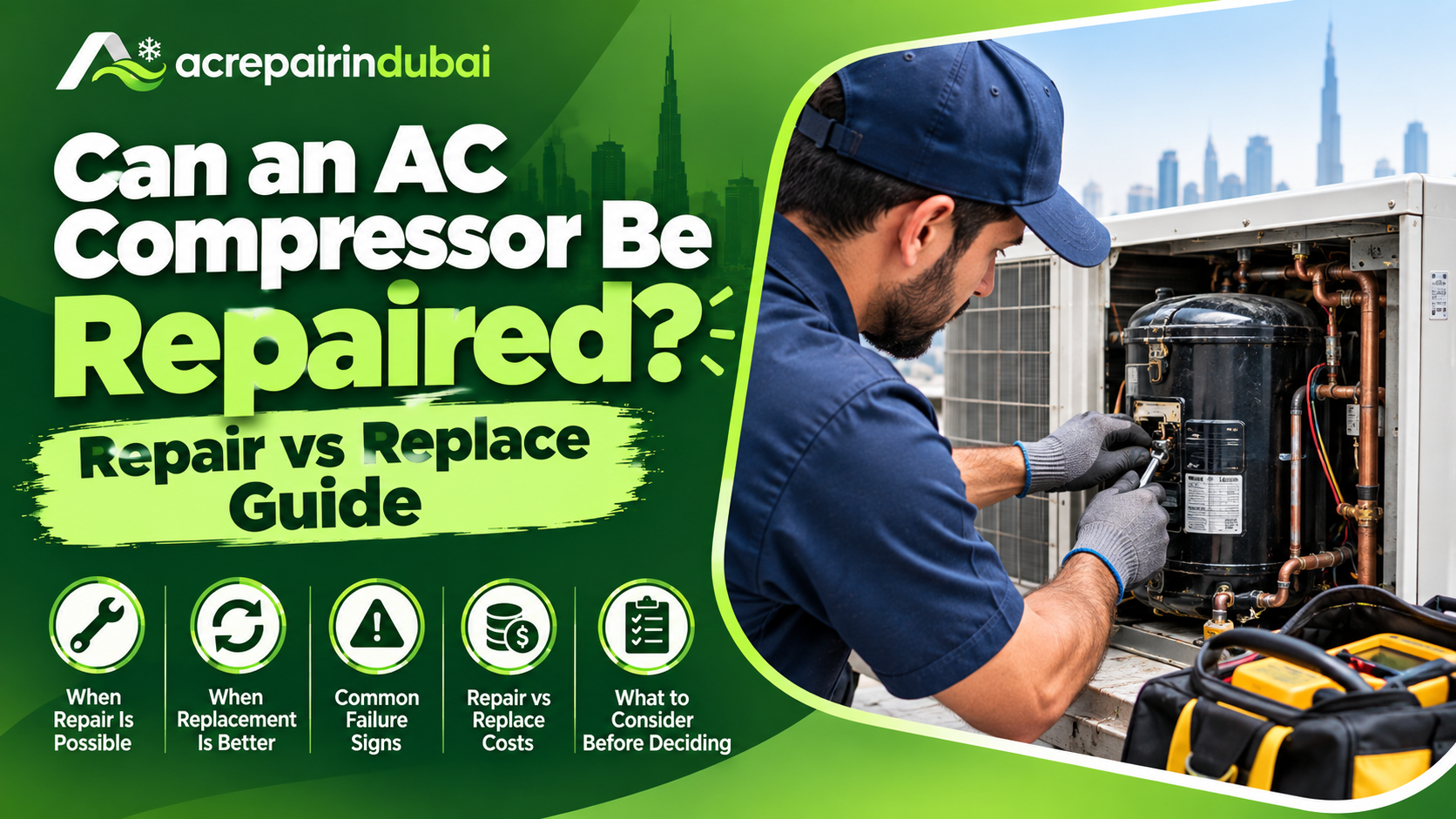
Sometimes. Most residential AC compressors are hermetically sealed, so internal damage (a seized motor, burnt windings, broken valves) cannot be repaired and the compressor must be replaced. However, many “dead compressor” calls turn out to be problems with the parts around it: a failed capacitor, a stuck contactor, a tripped breaker, loose wiring, or low refrigerant. Those are repairable, often for a few hundred dollars or less.
In this guide
- What an AC compressor does
- Can an AC compressor be repaired?
- Signs your compressor is failing
- Repair vs replacement cost
- Repair or replace: how to decide
- How to repair an AC compressor
- Can you repair a home AC compressor yourself?
- How to install an AC compressor
- FAQs
What an AC compressor does
The compressor sits inside the outdoor unit (the condenser) and is often called the heart of the air conditioning system. It pumps refrigerant through the loop. It takes in low-pressure refrigerant gas that has absorbed heat from your home, squeezes it into a hot, high-pressure gas, and sends it to the condenser coil, where the heat is released outdoors. Without a working compressor, refrigerant doesn’t move and your AC just blows room-temperature air.
Most homes use one of three types. Reciprocating compressors are piston-driven and common in older units. Scroll compressors use two spiral plates and are the standard in most modern systems. Variable-speed (inverter) compressors adjust their output to match demand and are found in high-efficiency systems and mini-splits. A typical residential compressor lasts about 10 to 15 years, roughly the life of the system itself.
Can an AC compressor be repaired?
It depends on what failed. Think of the compressor as two zones: the sealed shell with the motor and pump inside, and the external electrical and refrigerant components that keep it running.
| Problem | What’s happening | Verdict |
|---|---|---|
| Bad start/run capacitor | Compressor hums but won’t start; very common failure | Repairable |
| Failed contactor or relay | Outdoor unit gets no power signal, or stays on nonstop | Repairable |
| Loose or burnt wiring / terminals | Intermittent starts, tripped breakers, burning smell | Repairable |
| Hard-starting motor | Struggles and trips on startup as the motor ages | Hard start kit |
| Low refrigerant from a leak | Compressor overheats and short-cycles | Fix leak + recharge |
| Thermal overload tripping | Compressor shuts off when hot; often caused by a dirty coil or dead fan | Fix root cause |
| Seized or locked rotor | Motor physically can’t turn | Replace |
| Grounded or shorted windings | Breaker trips immediately; motor insulation has failed | Replace |
| Broken internal valves or scrolls | Runs but doesn’t build pressure; loud knocking | Replace |
Sealed (hermetic) compressors aren’t opened in the field. Once the fault is inside the shell, replacement is the only fix.
Some large commercial semi-hermetic compressors are bolted together and can be rebuilt. Those are rarely used in homes. For a typical residential split system or heat pump, “repairing the compressor” means repairing the components that feed it.
Signs your AC compressor is failing
- Warm air from the vents while the indoor blower runs normally.
- The outdoor fan spins but the compressor stays silent, or you hear a hum with no start. This often points to a capacitor.
- Loud noises such as grinding, rattling, or banging on startup, which can mean worn internal parts or loose mounts.
- The breaker trips repeatedly when the AC tries to start.
- Short cycling, where the unit turns on and off every few minutes.
- Higher electric bills with no change in how you use the AC.
- Refrigerant or oil stains around the outdoor unit or on the copper lines.
Several of these symptoms overlap with cheaper problems, so always get a proper diagnosis before paying for a new compressor. A good technician checks the capacitor, contactor, voltage, and winding resistance first.
AC compressor repair vs replacement cost (2026)
Prices below are typical U.S. ranges for residential central air, including parts and labor. Your quote will vary with system size, refrigerant type, warranty status, and local labor rates.
AC Compressor Repair vs Replacement Cost in Dubai (2026)
Prices below are typical 2026 ranges in Dubai for home ACs, in UAE dirhams (AED), including parts and labour. Your quote will vary with the AC type and tonnage, the brand, whether the part is under warranty, access to the outdoor unit, and 5% VAT.
| Job | Typical Cost (AED) | Notes |
|---|---|---|
| Inspection / call-out | AED 100–250 | Often waived if you go ahead with the repair |
| Capacitor replacement | AED 150–350 | The most common “compressor” fix |
| Contactor replacement | AED 200–400 | Quick job for a technician |
| Electrical / wiring repair | AED 200–500 | Burnt terminals, loose connections |
| Gas refill (one split unit) | AED 150–600 | Leak repair is quoted on top |
| Minor compressor repair | AED 400–800 | Hard start kit, overload, relay |
| Major compressor repair | AED 1,200–1,800 | Leak repair, recharge, several parts |
| Split AC compressor, 1–1.5 ton | AED 1,200–1,500 | Replacement, out of warranty |
| Split AC compressor, 2–3 ton | AED 2,000–4,000 | Replacement, out of warranty |
| Ducted / central AC compressor (apartment) | AED 2,000–5,000 | Depends on tonnage and access |
| Ducted / central AC compressor (villa) | AED 3,500–10,000+ | Larger multi-ton systems |
| New split AC, 1.5 ton (installed) | AED 2,500–4,500 | Comes with a new warranty |
| New split AC, 2 ton (installed) | AED 3,500–6,000 | Comes with a new warranty |
| New ducted system, 3–5 ton (installed) | AED 8,000–25,000 | Small to medium villa |
Refrigerant is a big cost driver right now. R-410A is still legal for servicing existing systems, but it is being phased down under the U.S. AIM Act, and prices have risen to about $90–$150 per pound in many areas. A home system holds roughly 5 to 12 pounds. Older R-22 systems are even more expensive to recharge, which makes a compressor replacement on them hard to justify.
Repair or replace: how to decide
Replace just the compressor if…
- The system is under about 8 years old
- The compressor is still under the manufacturer’s parts warranty (often 10 years if registered)
- The rest of the system (coils, fan motor, lines) is in good shape
- It uses R-410A or a newer refrigerant
Replace the whole system if…
- The unit is 12 years old or older
- It still uses R-22 refrigerant
- The compressor is out of warranty and the quote tops half the cost of a new unit
- You’ve had repeated repairs or high energy bills
A quick rule of thumb many contractors use is the $5,000 rule: multiply the unit’s age by the repair cost. If the result is over $5,000, replacement usually makes more sense. For example, a 12-year-old system with a $2,200 compressor quote gives 26,400, a clear vote for replacement. A 5-year-old system with a $900 warranty labor bill gives 4,500, so repairing is reasonable.
Also consider efficiency. A new compressor in a 13-year-old system keeps an old, less efficient setup running. A new system with a higher SEER2 rating can cut cooling bills noticeably and restarts your warranty on every major part.
How to repair an AC compressor
Here is how a technician typically works through a compressor that won’t run. The goal is to rule out the cheap fixes before condemning the compressor.
Safety first: The outdoor unit runs on 240 volts, and capacitors can hold a dangerous charge even with the power off. Handling refrigerant legally requires EPA Section 608 certification in the U.S. The steps below explain the process so you understand your technician’s work. They are not a DIY checklist.
- Check power and controlsConfirm the thermostat is calling for cooling, the breaker hasn’t tripped, and the outdoor disconnect is on. Check that 24-volt control voltage is reaching the unit.
- Test the capacitorWith the power off and the capacitor safely discharged, a meter measures its microfarad rating. A reading more than about 6% below the label, or a bulging top, means it needs replacing.
- Inspect the contactorPitted, burnt, or stuck contacts stop power from reaching the compressor. Replacing the contactor is a quick fix.
- Check wiring and terminalsLoose, corroded, or melted connections are tightened or replaced. Burnt terminals on the compressor itself can point to a deeper problem.
- Measure the windingsAn ohmmeter checks resistance across the compressor’s common, start, and run terminals, and between each terminal and ground. An open or grounded winding means the compressor is finished.
- Try a hard start kitIf the windings test fine but the motor struggles to start, a hard start kit gives it an extra boost and can add years of service.
- Check refrigerant pressuresGauges show whether the charge is low. If it is, the leak gets found and repaired before recharging. Topping off without fixing the leak only delays the next failure.
- Clean the condenser coil and check the fanA dirty coil or dead fan motor makes the compressor overheat and trip its internal overload. Fixing airflow often fixes the “compressor” problem.
Can you repair a home AC compressor yourself?
You can handle a few basic checks safely: make sure the thermostat is set to cool, reset a tripped breaker once, replace a dirty air filter, and hose debris off the outdoor coil with the power off. These small steps fix a surprising number of “my AC stopped cooling” calls.
Beyond that, compressor work is a job for a licensed HVAC technician, for three reasons:
- Electrical risk. High voltage and stored charge in capacitors can cause serious injury.
- Refrigerant rules. Venting refrigerant is illegal, and buying or handling most refrigerants requires certification. Recovery also takes special equipment.
- Warranty. Most manufacturers void compressor warranties when the work isn’t done by a licensed contractor.
Some experienced homeowners do replace capacitors or contactors themselves, but a mistake can damage a healthy compressor or cause injury. If you aren’t comfortable working with 240-volt equipment, leave it to a professional. In a hot climate like the UAE, where an AC can run almost all year, it pays to call a qualified technician early. If you’re based in the Emirates, a specialist in AC repair in Dubai can test your compressor and its parts and tell you whether a repair or a replacement makes more sense.
How to install an AC compressor
A compressor replacement is not a simple bolt-in swap. It usually takes a technician 4 to 8 hours. Here is what a proper installation includes, so you can check that your contractor isn’t skipping steps.
- Confirm the diagnosis and the partThe new compressor must match the system’s capacity, voltage, and refrigerant type. Warranty claims are filed at this stage.
- Kill power and recover refrigerantPower is shut off at the breaker and disconnect. All refrigerant is pumped into a recovery tank, never vented.
- Remove the old compressorWiring is labeled and disconnected, the suction and discharge lines are cut or unbrazed, and the mounting bolts come out.
- Check for burnout and clean the systemIf the old compressor burned out, the oil may be acidic. The technician tests it and flushes the lines or installs an acid-removal filter drier to protect the new compressor.
- Set and braze the new compressorThe new unit is mounted on new isolation grommets and brazed into place while dry nitrogen flows through the lines to prevent internal scale.
- Install a new filter drierThis is required by most manufacturers for warranty coverage. A new capacitor and contactor are also commonly installed.
- Pressure test for leaksThe system is pressurized with nitrogen and checked to make sure every joint holds.
- Pull a deep vacuumA vacuum pump removes air and moisture until a micron gauge reads about 500 microns or lower and holds steady.
- Charge and commissionRefrigerant is weighed in to the manufacturer’s spec, then fine-tuned using superheat or subcooling readings. The technician checks amp draw and temperature split across the indoor coil.
Frequently asked questions
Can an AC compressor be fixed without replacing it?
Yes, if the problem is outside the sealed shell. Capacitors, contactors, wiring, a hard start kit, or a refrigerant leak repair can all bring a “dead” compressor back. Internal mechanical or electrical failures require replacement.
Is it worth replacing a compressor on a 10-year-old AC?
Usually only if the compressor is still under warranty or the rest of the system is in excellent shape. Out of warranty, an out-of-pocket compressor swap on a 10+ year-old unit often costs close to a new outdoor unit that comes with a fresh 10-year warranty.
Why is my AC fan running but the compressor isn’t?
The most common cause is a failed capacitor. Other causes include a bad contactor, a tripped thermal overload from a dirty coil, low refrigerant, or a failed compressor motor. A technician can tell which with a few meter tests.
Does tapping or hitting the AC unit really fix the compressor?
This viral trick sometimes gets a unit running because it frees a stuck contactor or jolts a weak capacitor. It’s a temporary sign that a part is failing, not a fix. Hitting the unit can also damage it, so call a technician instead.
Can a bad capacitor damage the compressor?
Yes. A weak capacitor makes the compressor struggle and overheat each time it starts. Over time that stress can burn out the windings. Replacing a failing capacitor early is cheap insurance.
How long does an AC compressor last?
Most last 10 to 15 years. Regular maintenance, clean coils, the correct refrigerant charge, and good airflow help it reach the upper end of that range.
Can I run my AC with a bad compressor?
It’s not a good idea. A failing compressor cools poorly, uses more electricity, and can trip breakers or overheat wiring. Turn the system off and schedule a diagnosis.
Does home insurance or a home warranty cover AC compressor failure?
Homeowners insurance usually covers only sudden damage from covered events like lightning or fire, not wear and tear. A home warranty or the manufacturer’s parts warranty is more likely to cover a failed compressor. Check your paperwork and whether the unit was registered.
How long does it take to replace an AC compressor?
Most replacements take 4 to 8 hours of work. Getting the part, especially under a warranty claim, can add a few days.
Can a compressor be rebuilt?
Hermetic compressors used in homes aren’t rebuilt in the field. Some large commercial semi-hermetic compressors can be rebuilt, and remanufactured compressors exist mostly for cars.
What is the $5,000 rule for AC repair?
Multiply the age of your unit by the repair cost. If the total is more than $5,000, replacing the system is usually the better long-term value.
The bottom line
An AC compressor can be repaired when the fault is in its capacitor, contactor, wiring, or refrigerant charge. A compressor that has failed inside its sealed shell has to be replaced. Whether to replace just the compressor or the whole system comes down to age, warranty, refrigerant type, and cost. For a newer system under warranty, a compressor swap is usually worth it. For a system past 12 years or running on R-22, new equipment is almost always the better investment. Either way, start with a thorough diagnosis from a licensed technician so you don’t pay for a compressor you didn’t need.