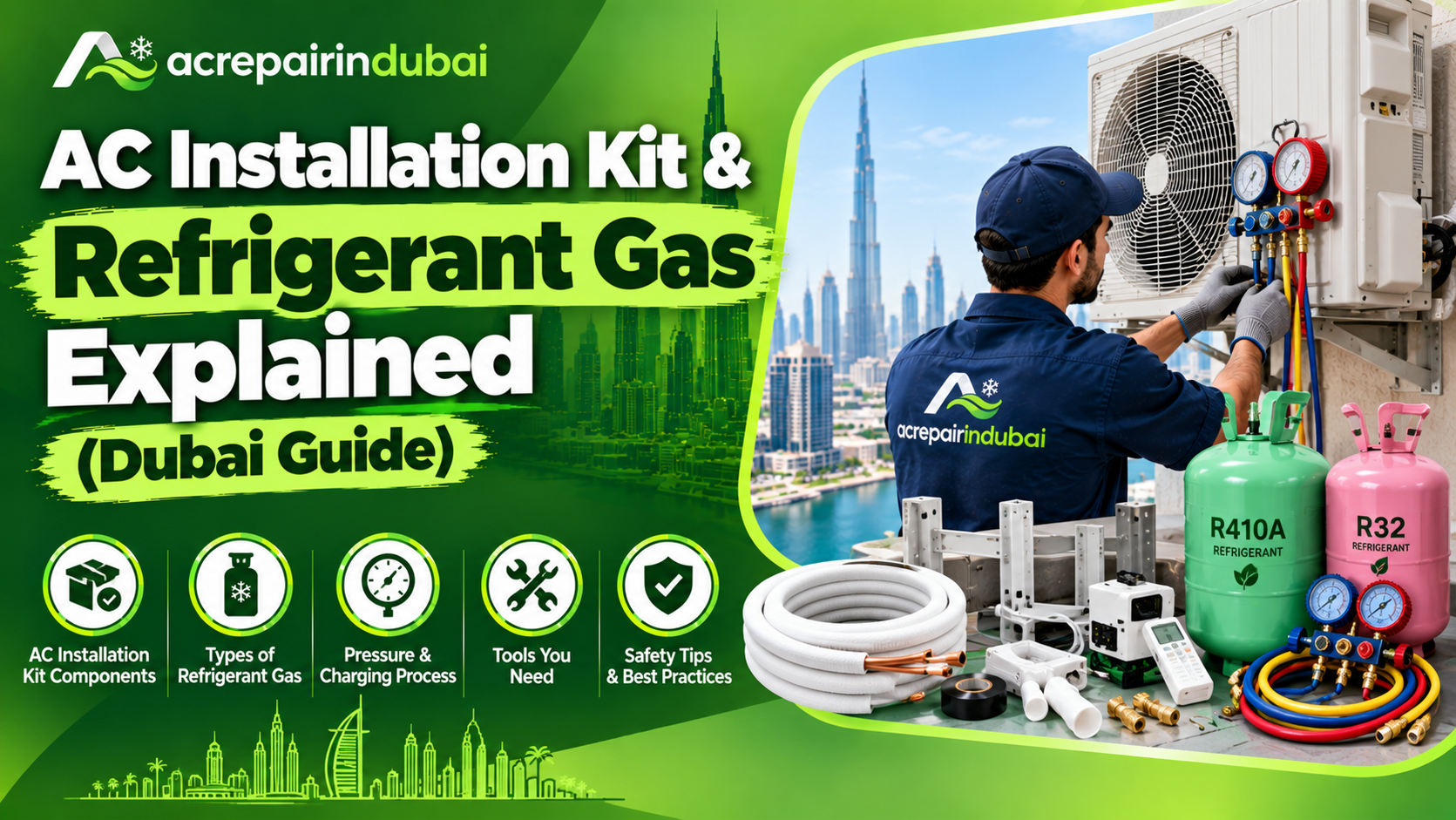
This guide explains every part of a standard AC installation kit, what each one does, and the different refrigerant gases used in ACs today: R32, R410A, R22 and others. Knowing this helps you compare quotes properly and spot an installer who’s cutting corners. If you’d rather leave the details to professionals, our AC installation service in Dubai uses quality materials and tells you exactly what’s included.
What Does an AC Installation Kit Include?
An AC installation kit is the set of materials needed to connect the indoor and outdoor units of a split AC. Most standard kits in Dubai cover about 3 metres of pipe run. Here’s what a complete kit should contain:
| Part | What It Does |
| Copper pipes (2 lines) | Carry refrigerant gas between the indoor and outdoor units |
| Pipe insulation | Stops the cold pipes from sweating and losing cooling |
| Drain pipe | Carries condensate water away from the indoor unit |
| Communication / power cable | Connects the indoor and outdoor units electrically |
| Flare nuts | Seal the copper pipe connections at both units |
| Outdoor unit bracket or stand | Holds the outdoor unit securely |
| Wall sleeve | Protects the pipes where they pass through the wall |
| PVC tape | Wraps the pipes, cable and drain line into one neat bundle |
| Anchors, screws and bolts | Fix the indoor plate and outdoor bracket |
| Anti-vibration pads | Reduce noise and vibration from the outdoor unit |
Some installers also include pipe cover trunking, a plastic channel that hides the pipes on the wall. This is often charged separately.
Each Part of the Kit Explained
1. Copper Pipes
Every split AC needs two copper pipes: – Liquid line (smaller pipe): carries liquid refrigerant from the outdoor unit to the indoor unit. – Suction or gas line (larger pipe): carries refrigerant gas back to the outdoor unit.
Pipe size depends on the AC’s capacity. Common sizes for home split ACs are 1/4” with 3/8” or 1/4” with 1/2”, and larger units use bigger pipes. The correct sizes are always printed in the installation manual.
Quality matters. Proper ACR-grade copper (made for air conditioning and refrigeration) has the right wall thickness to handle high pressures, especially with R410A and R32 gas. Thin or low-grade pipes can crack or leak over time. Some cheap installers use thin copper or even aluminium pipes to save money.
2. Pipe Insulation
Both copper pipes must be wrapped in closed-cell foam insulation, usually black rubber foam. Without it: – The pipes sweat and drip water on walls and ceilings – Cooling is lost before it reaches the room – In Dubai’s heat, the outdoor section of the pipe absorbs heat and reduces efficiency
Check that the insulation covers the pipes completely, including at the joints, and that it’s thick enough. Thin insulation breaks down quickly in the UAE sun.
3. Drain Pipe
The indoor unit removes moisture from the air, and that water needs to go somewhere. A flexible PVC drain pipe carries it to a drain point or outside. It must slope downward the whole way. Any dip or upward section causes water to back up and leak from the indoor unit.
4. Communication and Power Cable
This cable connects the indoor and outdoor units so they work together. It must be the correct size and number of cores for your AC model. Undersized cable can overheat, which is a fire risk.
5. Flare Nuts
These brass nuts connect the copper pipes to the service valves on both units. The pipe end is shaped with a flaring tool, then tightened to the correct torque. A poor flare is one of the most common causes of slow gas leaks.
6. Outdoor Bracket or Stand
The outdoor unit sits on a wall bracket or a floor stand. Brackets must be rated for the unit’s weight and fixed with proper anchor bolts. In Dubai, galvanised or powder-coated steel lasts longer in the heat and humidity.
7. Wall Sleeve
A plastic sleeve lines the hole drilled through the wall. It protects the pipes and cable from sharp edges and helps seal the hole against dust and insects.
What Isn’t Usually Included?
Most installation quotes cover a standard kit only. These are often charged as extras:
• Extra copper piping beyond the standard length (usually charged per metre)
• Extra refrigerant gas for long pipe runs
• Pipe cover trunking
• Drain pump, if water can’t drain by gravity
• Core drilling through concrete
• New power point or isolator switch
Always ask the installer what length of pipe is included and how extras are charged. See our AC installation cost in Dubai guide for typical prices.
Which Gas Is Used for AC Installation?
The refrigerant gas is what actually moves heat out of your home. It circulates between the indoor and outdoor units, absorbing heat inside and releasing it outside.
Most new split ACs sold in Dubai today use R32 or R410A. Older ACs may still run on R22. You can check which gas your AC uses on the nameplate sticker on the outdoor unit.
R32
• Used in most new inverter split ACs from major brands
• More energy efficient than R410A
• Lower global warming impact than R410A
• Needs less gas for the same cooling
• Mildly flammable, so installers must follow the correct handling procedures
R410A
• Was the standard for split ACs for many years and is still common
• Non-flammable
• Works at higher pressure than R22, so it needs proper pipes and fittings
• Has a high global warming impact, so many manufacturers are moving to R32
R22
• The old standard gas, found in older ACs
• Being phased out worldwide under the Montreal Protocol because it damages the ozone layer
• Becoming harder to find and more expensive to refill
• If an old R22 AC needs a major repair, replacing it is often the better long-term choice
Other Gases You May See
• R407C: Found in some older ducted and package units.
• R290 (propane): Used in some window and portable ACs. Very efficient and low impact, but highly flammable, so it needs careful handling.
Quick Comparison: R32 vs R410A vs R22
| Feature | R32 | R410A | R22 |
| Used in | Most new split ACs | Many split ACs (2010s onwards) | Older ACs |
| Efficiency | High | Good | Lower |
| Environmental impact | Lower | High | Damages ozone layer |
| Flammability | Mildly flammable | Non-flammable | Non-flammable |
| Availability | Easy | Easy | Being phased out |
Can You Mix or Change AC Gas?
No. Each AC is designed for one specific refrigerant. You should never: – Mix two gases in the same system – Top up an R410A AC with R32, or the other way round – Convert an R22 system to R410A without changing major components, because the pressures and oils are different
Using the wrong gas can damage the compressor and void the warranty. A good technician always checks the nameplate before adding gas.
Does AC Gas Need to Be Refilled Every Year?
No. AC gas runs in a sealed loop and doesn’t get used up. If your AC is low on gas, it means there’s a leak somewhere, usually at a flare joint, a damaged pipe or a corroded coil.
Simply topping up the gas without fixing the leak is a short-term fix. The gas will escape again, and you’ll pay for another refill. Always ask the technician to find and fix the leak first.
Signs your AC may be low on gas: – Weak or warm air from the indoor unit – Ice forming on the copper pipes – A hissing sound near the pipes – Higher electricity bills with less cooling
If you notice these, read our guide on how to fix common AC cooling problems.
Is Gas Included When You Install a New AC?
Yes. New split ACs come pre-charged with enough gas for a standard pipe length, usually around 5 to 7.5 metres depending on the model. If your pipe run is longer, the installer will need to add extra gas. A gas top-up in Dubai usually costs around AED 250–450.
Before releasing the gas, the installer must vacuum the pipes to remove air and moisture. This step is essential: moisture inside the system mixes with the refrigerant oil and slowly damages the compressor.
How to Make Sure You’re Getting a Quality Kit
Before the installer starts, ask:
1. Is the copper ACR-grade, and what wall thickness is it?
2. What insulation is used, and how thick is it?
3. How many metres of pipe are included?
4. Will you vacuum the lines before releasing the gas?
5. Which gas does my AC use, and is any top-up included?
A trustworthy installer will answer clearly and show you the materials before fitting them.
Frequently Asked Questions
What is included in an AC installation kit?
A standard kit includes two insulated copper pipes, a drain pipe, a communication cable, flare nuts, an outdoor bracket or stand, a wall sleeve, PVC tape, and fixing anchors and screws. It usually covers about 3 metres of pipe run.
Which gas is used in AC installation?
Most new split ACs use R32 or R410A gas. Older ACs may use R22, which is being phased out. Check the nameplate on your outdoor unit to see which gas it uses.
Which is better, R32 or R410A?
R32 is more energy efficient and has a lower environmental impact, which is why most new ACs use it. R410A is non-flammable and still widely used. Both work well when installed correctly.
Can I use R32 gas in an R410A AC?
No. Each AC is designed for one specific gas. Using the wrong refrigerant can damage the compressor and void the warranty.
How long does AC gas last?
AC gas should last the lifetime of the unit if there are no leaks. If you need regular gas refills, there’s a leak that needs fixing.
Why is copper pipe quality important?
Modern refrigerants work at high pressure. Thin or low-grade copper can crack or leak, causing gas loss, poor cooling and repeat repair costs.
Get a Proper Installation with Quality Materials
The installation kit and the right gas charge matter as much as the AC itself. Cheap pipes, thin insulation or a skipped vacuum can lead to leaks, poor cooling and compressor damage within a year or two. Our technicians use quality copper, proper insulation and correct gas procedures on every job, with clear written quotes.