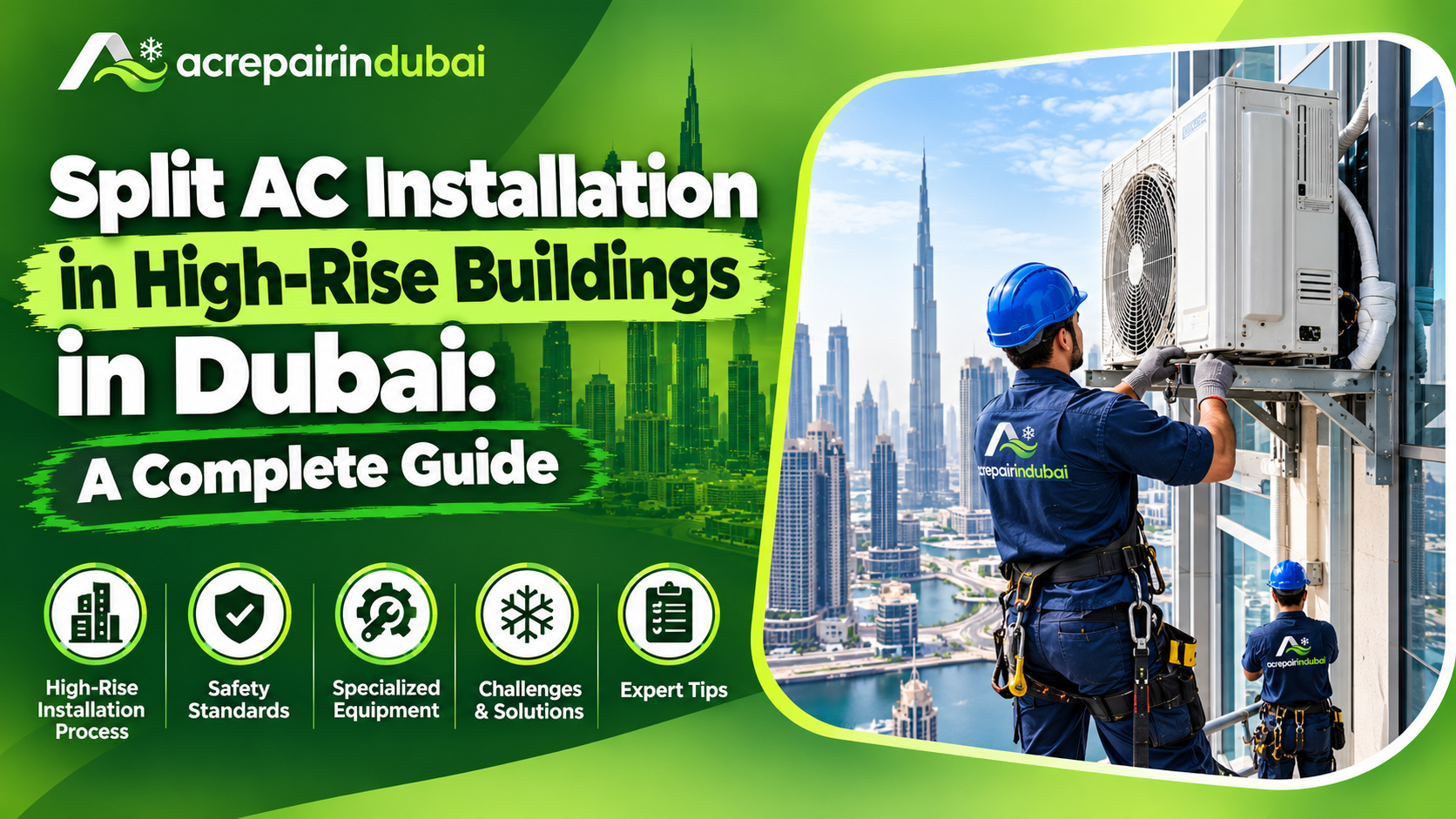
Installing a split AC in a Dubai tower is not the same as installing one in a villa. You have to think about building rules, where the outdoor unit can go, safety at height, drainage, and a pipe run that may pass through a curtain wall or a pre-built sleeve. Get any of these wrong and you could face a failed building inspection, water dripping onto the balcony below, or an AC that trips every afternoon in August.
This guide explains how to install a split AC in a high-rise building, what building management will ask for, and where the outdoor unit can safely go. If you’d rather leave it to a team that works in Dubai towers every day, our AC installation service in Dubai covers everything from approvals to final testing.
Check This First: Does Your Building Allow Split ACs?
Before you buy a unit, confirm with your building management or landlord that split ACs are allowed. Many Dubai towers, especially in areas like Dubai Marina, JLT, Downtown and Business Bay, run on district cooling or a central chilled-water system. In those buildings:
- Every room already has a fan coil unit connected to the central system.
- Outdoor units are often not allowed on balconies or facades.
- Adding a split AC may need special approval, or may not be permitted at all.
Older buildings, and towers in areas like Al Nahda, Al Qusais, Deira and International City, are more likely to allow split units. Some even have designated AC ledges or service areas for outdoor units.
Rule of thumb: If your apartment already has AC vents in the ceiling and you pay a separate chiller or cooling bill, you’re probably on central or district cooling. Speak to building management before going further.
Approvals and Paperwork
Most high-rise buildings in Dubai need written permission before any AC installation. Expect to be asked for:
- Landlord NOC if you’re a tenant
- Building management approval for work permits, access and working hours
- Contractor details, often including a trade licence and insurance
- Method statement in some managed buildings, explaining how the work will be done safely
- Service lift booking to move the outdoor unit
Many towers only allow noisy work such as core drilling during set hours on weekdays. Build this into your schedule, because a job that takes 3 hours in a villa can take a full day in a tower once you add permits and lift bookings.
Where to Place the Outdoor Unit in a High-Rise
Placement is the biggest decision in any high-rise split AC installation. Here are the common options:
1. Balcony Floor Stand
This is the most common and safest option. The outdoor unit sits on a rubber-footed stand on the balcony floor. There’s no drilling into the outer wall and no one needs to lean out over the edge.
Watch for: Enough space around the unit for airflow, and a proper drain point for condensate water.
2. Designated AC Ledge or Service Area
Some buildings have a built-in ledge, a shaft, or a louvred enclosure made for outdoor units. Always use these if your building has them, because they’re designed for the purpose and usually required by the building rules.
3. Wall Bracket on the Facade
This is sometimes possible on lower floors of older buildings, but most Dubai towers don’t allow it because of facade rules and safety risks. Installing a bracket at height needs proper rope access or a gondola, and it should only be done by a trained, insured team.
4. Roof Installation
This works if you’re on the top floor or two, but pipe length becomes a problem for lower floors (see below).
Can You Install the AC Outdoor Unit in a Closed Area?
This is one of the most common questions from apartment owners. The short answer: only if the space has enough ventilation.
The outdoor unit works by pushing hot air out of your home. If it’s placed in a closed space, such as a laundry room, a fully enclosed balcony or a small shaft, that hot air has nowhere to go. The unit then sucks its own hot air back in. In Dubai summer, this causes:
- Weak cooling during the hottest hours of the day
- The compressor overheating and tripping
- Much higher electricity bills
- Shorter compressor life
If a semi-closed area is your only option, make sure:
- There’s a louvred opening or grille in front of the fan so hot air can escape
- The unit has clearance on all sides. As a general guide, keep at least 30 cm behind and to the sides and 50 cm or more in front, but always follow the manufacturer’s manual.
- The fan points toward the opening, not at a wall
- Nothing is stored around or on top of the unit
A fully sealed room with no airflow is never suitable for an outdoor unit.
Pipe Length and Height Difference
In a villa, the indoor and outdoor units are usually close together. In a tower, they can be far apart. This matters because every split AC has limits on:
- Maximum pipe length between the two units
- Maximum height difference between them
For most residential split ACs, the height limit is usually 10–15 metres, but it varies by model. Going beyond the limit means the compressor struggles to push oil and refrigerant back up. That leads to poor cooling and early compressor failure.
Longer pipe runs also need extra refrigerant gas added during installation, and all copper piping must be properly insulated to stop sweating and water damage inside walls or false ceilings.
Drainage: Don’t Let Water Drip on the Balcony Below
Split ACs produce a lot of condensate water in Dubai’s humid months. In a tower, that water can’t just drip out of the unit. It will land on the balcony below, cause complaints, and may break building rules.
A proper high-rise installation should:
- Connect the indoor unit drain to an existing drain point in the apartment
- Route the outdoor unit’s water to a balcony floor drain
- Use a condensate drain pump if water can’t flow down by gravity
- Keep the drain pipe sloping downward with no dips where water can collect
Safety at Height
This is where many cheap installers cut corners, and it’s the most dangerous part of the job. A responsible team will:
- Never lean over a balcony railing without a safety harness tied to a fixed anchor point
- Install from the inside and balcony side wherever possible
- Use certified rope access or gondola teams for any facade work
- Secure all tools and parts so nothing can fall
- Carry public liability insurance in case of accidents
If an installer suggests hanging the outdoor unit outside the balcony railing without proper equipment, stop the job.
Wind, Heat and Vibration at Height
Upper floors face stronger winds and more direct sun than ground-level villas. For a long-lasting installation:
- Use anti-vibration pads under the outdoor unit so noise doesn’t carry into the building structure
- Anchor stands or brackets firmly, using proper anchor bolts rated for the unit’s weight
- Choose a T3-rated or high-ambient model designed to keep cooling in very high outdoor temperatures
- Shade the outdoor unit from direct afternoon sun if possible, without blocking its airflow
Step-by-Step: How a Split AC Is Installed in a High-Rise
- Site survey: The technician checks the wall type, outdoor unit location, drain points and power supply, and measures the pipe run.
- Approvals: NOC, work permit and service lift booking.
- Indoor unit mounting: The mounting plate is fixed level on the wall, slightly angled toward the drain side.
- Core drilling: A hole is drilled through the wall, or an existing sleeve is used. Glass curtain walls must never be drilled.
- Outdoor unit placement: The unit goes on a floor stand, ledge or approved bracket with anti-vibration pads.
- Piping and wiring: Insulated copper pipes, drain line and communication cable are connected between both units.
- Vacuuming: The lines are vacuumed to remove air and moisture. This is a critical step and should never be skipped.
- Gas check and top-up: Pressure is checked and extra gas added for longer pipe runs.
- Testing: Cooling, drainage and noise levels are tested, and the area is cleaned.
How Much Does High-Rise Split AC Installation Cost?
A standard split AC installation in Dubai usually costs AED 300–700 for labour only. In high-rise buildings, expect extra charges for:
- Longer copper pipe runs
- A condensate drain pump
- Core drilling through concrete
- Balcony floor stands
- Rope access or gondola work, if facade installation is required and approved
Frequently Asked Questions
Can I install a split AC in my Dubai apartment?
Yes, if your building allows it. Many towers on district cooling don’t permit outdoor units on balconies or facades. Always check with building management and get a landlord NOC first.
Where should the outdoor unit go in a high-rise apartment?
The balcony floor or a designated AC ledge is the safest and most common choice. Facade brackets are rarely allowed in modern towers and need specialised equipment.
Can the AC outdoor unit be installed in a closed area?
Only if there’s good ventilation, such as a louvred opening in front of the fan and enough clearance around the unit. A fully enclosed space will cause overheating and poor cooling.
How long does split AC installation take in a high-rise?
The installation itself usually takes 3–5 hours. Approvals and lift bookings can add a few days, so plan ahead.
Why does my split AC trip in the afternoon?
In high-rises, this often happens because the outdoor unit is in a closed or poorly ventilated space and is recirculating its own hot air. A technician can check placement and airflow.
Get Your High-Rise Split AC Installed the Right Way
A split AC in a Dubai tower needs more than a quick fitting. It needs the right approvals, safe placement, proper drainage and a team trained to work at height. Our technicians handle split AC installations in apartments across Dubai, from paperwork to final testing, with clear written quotes.