
Your split AC all of a sudden operates without cooling properly, produces unusual sounds or uses a lot of energy but you cannot determine the exact cause of the situation. Such exasperating symptoms can be traced to damaged or worn components that silently continue to degrade, ultimately leading to a total system breakdown.
Understanding how damaged split ac unit parts cause failures empowers you to identify problems early, prevent cascading damage, and protect your cooling investment. This guide reveals five critical ways faulty components compromise your entire system and how timely replacement of damaged split ac unit parts prevents minor issues from escalating into major expensive emergencies.
How Do Faulty Split AC Indoor Unit Parts Affect Cooling Performance?
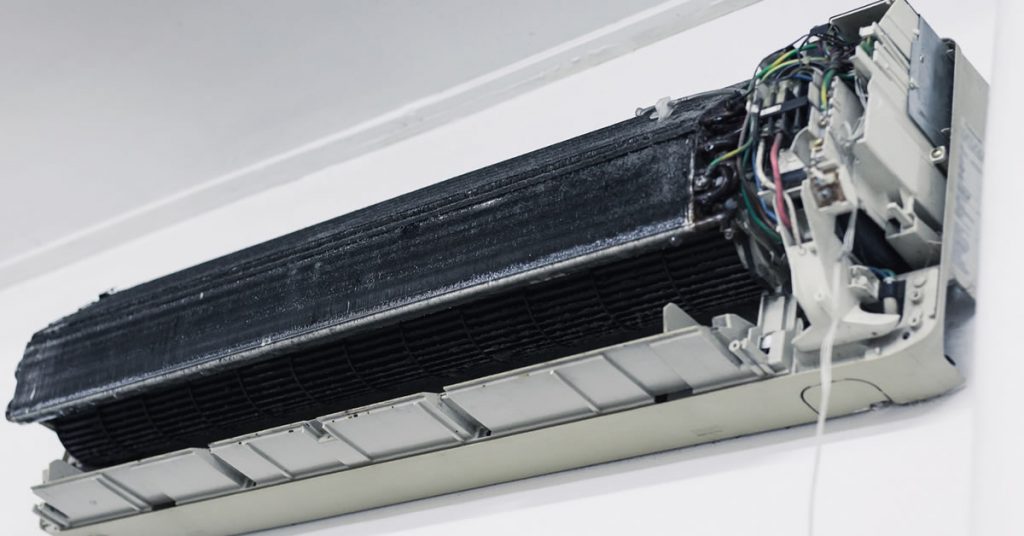
Faulty split ac indoor unit parts affect cooling performance by restricting airflow through clogged filters and dirty coils, reducing heat transfer efficiency, causing refrigerant flow problems, and preventing proper temperature regulation throughout served spaces.
The components in the indoor units directly affect the cooling provided to your living areas. When ac indoor unit parts like evaporator coils accumulate dirt, they cannot absorb heat effectively from indoor air. Blocked filters limit air flow minimizing the volume of air passing through the coils whereas damaged fans do not move sufficient air in the system.
Damaged ac indoor unit parts also trigger secondary problems affecting other components. Limited airflow is such that coils freeze due to insufficient heat load, the accumulation of ice prevents the further flow of air, and liquid refrigerant clouds back to the compressor and damages it.
Why damaged ac indoor unit parts reduce airflow efficiency
Damaged ac indoor unit parts reduce airflow efficiency when clogged filters create resistance, dirty blower wheels lose balance and effectiveness, blocked drainage causes water backup, and deteriorated fan motors struggle to maintain proper speed.
Blower motors that overcome airflow resistance from contaminated filters dissipate additional electrical power and increase motor wear. Dust on blower wheels causes an imbalance, resulting in vibration, noise, and reduced airflow capacity.
How worn indoor split ac parts trigger temperature imbalance
Worn indoor ac parts trigger temperature imbalance through faulty thermostats providing incorrect readings, damaged expansion valves disrupting refrigerant flow, dirty coils preventing even heat absorption, and failed motors creating inconsistent air distribution.
Inconsistency in the temperature implies certain component failures that should be addressed. The rooms that are further away than the indoor unit heating up indicate a fan motor problem or leakages in the ducts. Quick change in temperature means that there is a problem with thermostats or sensors.
Can Damaged Split Unit AC Parts Cause Compressor Failure?
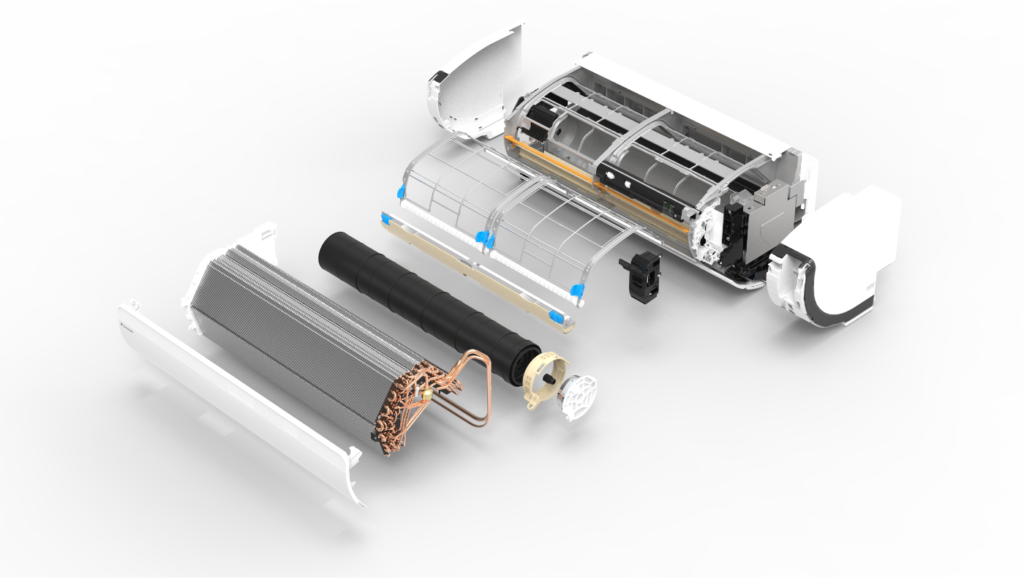
Damaged split unit ac parts definitely cause compressor failure through electrical issues creating power surges, refrigerant problems from leaks or contamination, inadequate lubrication from low refrigerant, and mechanical failures from debris or liquid flooding.
Compressors represent the most expensive split ac unit parts, typically costing AED 1,500-3,500 to replace. Compressor-related failures are usually caused by other systems components instead of the faults of the compressor. Damages to windings due to hard starting are caused by electrical problems such as broken capacitors or contactors.
Preventing compressor failure requires maintaining all ac unit parts properly. Changing of filters regularly avoids the airflow being blocked, cleaning of coils after every annual check ensures that heat is transferred, all electrical components are checked to detect faulty parts and refrigerant pressure is checked to detect any leakage before the compressor begins to run out of control.
How electrical faults in split unit ac parts impact compressor health
Electrical faults in ac unit parts have a direct and damaging impact on compressor health because the compressor relies on stable voltage and correct electrical signals to operate smoothly. Defective capacitors may prevent the compressor from starting or draw excessive current, leading to overheating and internal damage. Broken connectors and loose wiring contribute to high voltage variation and resistance, imposing a constant strain on compressor windings. Failure of control boards and power surges may transmit the wrong commands leading to short cycling or abnormal operation which reduces the compressor life. Such electrical problems eventually cause safety switches to malfunction, leading to frequent shutdowns that substantially increase the risk of total compressor burnout.
Why ignoring minor split ac spare parts issues leads to major breakdowns
Ignoring minor ac spare parts issues leads to major breakdowns because small problems cascade into multiple component failures, temporary malfunctions become permanent damage, efficiency losses compound over time, and minor repairs escalate into expensive replacements.
The replacement of a defective capacitor, which may break down the compressor motor with resulting value of AED 2,000 and above, costs the AED 100-150, which can be ignored. Even the slow loss of charge in a small leak of refrigerant leads to compressor lubrication loss and mechanical seizure.
5 Common Ways Damaged Split AC Unit Parts Lead to System Failure
Damaged split ac unit parts lead to system failure through five primary mechanisms: reduced cooling efficiency from contaminated heat exchangers, frequent breakdowns from worn mechanical components, increased power consumption, airflow and noise issues, and shortened lifespan.
1. Faulty AC Indoor Unit Parts Reduce Cooling Efficiency
Faulty AC Indoor Unit Parts Reduce Cooling Efficiency Contaminated evaporator coils, clogged filters, dirty blower wheels, and failed expansion valves reduce heat transfer capacity by 20-40%, forcing systems running continuously without achieving desired temperatures.
2. Worn-Out AC Parts Lead to Frequent System Breakdowns
Worn-Out AC Parts Lead to Frequent System Breakdowns. Deteriorated capacitors, worn contactors, failing fan motors, and damaged sensors cause intermittent failures requiring repeated service calls. There is a risk of secondary damage of other parts in case of each breakdown.
3. Damaged Split Unit AC Parts Increase Power Consumption
Damaged Ac Parts Increase Power Consumption. Friction from worn bearings, electrical resistance from electrical faults, airflow restriction from contaminated components, and refrigerant leaks all increase runtime, raising electricity consumption by 25-50%.
4. Defective Split AC Spare Parts Cause Airflow and Noise Issues
Defective AC Spare Parts Cause Airflow and Noise Issues. Imbalanced blower wheels, worn motor bearings, loose mounting hardware, and damaged fan blades create excessive noise, vibration, and reduced air movement.
5. Neglected AC Parts Shorten Overall System Lifespan
Neglected AC Unit Parts Shorten Overall System Lifespan Cumulative stress from operating with damaged components reduces expected 15-20 year lifespan to 8-12 years. Contaminated components lead to untimely wear of costly components.
Why Do Dirty or Broken AC Unit Parts Increase Energy Consumption?
Dirty or broken ac parts increase energy consumption by creating airflow resistance, requiring more blower power, reducing heat transfer efficiency forcing longer runtime, causing mechanical friction from wear, and triggering inefficient operation from control problems.
Dirty coils act as insulators, preventing efficient heat transfer, and systems that operate at 30-50% of the desired cooling time are required to achieve the target temperature. Dirty filters block airflow, increasing the work required of blower drives to overcome resistance.
Energy consumption increases from damaged ac parts compound monthly–a 25% efficiency loss on a system consuming AED 300 monthly means AED 75 wasted every month, totaling AED 900 annually.
How damaged ac parts force longer cooling cycles
Damaged ac parts force longer cooling cycles when dirty coils reduce heat absorption rates, refrigerant leaks decrease system capacity, airflow restrictions limit cooling delivery, and failed thermostats prevent recognizing achieved temperatures.
Efficient systems achieve thermostat levels in 10-15 minutes and intermittently turn off, with temperatures being maintained. The system with damaged parts is running 30-60 minutes or indefinitely without attaining settings.
Why energy loss accelerates split ac parts wear
Energy loss accelerates ac parts wear because extended runtime increases operating hours on all components, higher temperatures from inefficiency stress materials, continuous operation prevents cooling periods, and excessive cycling fatigues electrical components.
Components that are intended to work intermittently do not perform well when it is operated at full speed. The motors are overheated because of poor cooling between periods, electric contacts are worn out because of excessive switching and mechanical wear compounds are worn out because of more operating hours.
How Do Drainage and Moisture-Related Split AC Indoor Unit Parts Cause Damage?
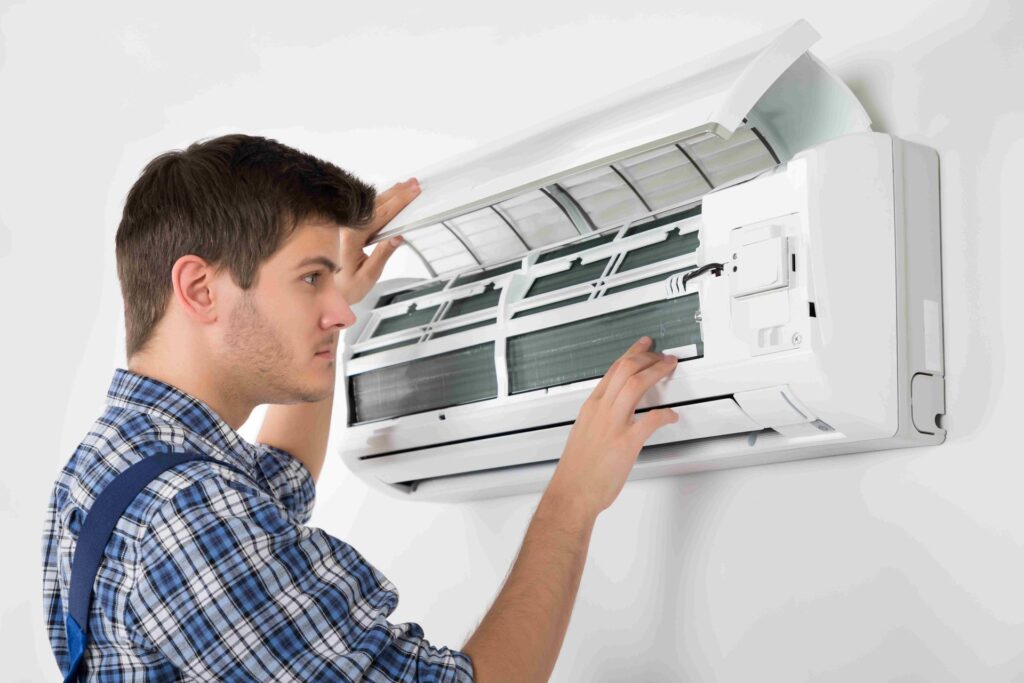
Drainage and moisture-related ac indoor unit parts cause damage when clogged drain lines create water overflow damaging ceilings and walls, standing water breeds bacteria and mold, excess moisture corrodes electrical components, and humidity causes short circuits.
Correct drainage of condensate is also of paramount importance in the wellbeing of systems and the safety of the building. Air conditioning process creates a lot of water inside the house, the average domestic air conditioning unit would create 5-20 liters of water per day, depending on the humidity and length of operation.
Moisture problems with ac indoor unit parts also affect system performance and reliability. The water that accumulates behind unit decays electrical wiring, leads to the breakdown of control boards, and emits stenchy smells that are scattered in habitable areas.
Why blocked drainage ac indoor unit parts affect electronics
Blocked drainage, split ac indoor unit parts, affect electronics when water overflows onto circuit boards, causing short circuits. Moisture creates corrosion on electrical connections, humidity condensation damages sensors, and water intrusion voids warranties.
The indoor units use electronic components that are usually mounted above the drain pans presuming that they are drained. Pans overflowing expose costly circuit boards, thermistors, and control modules to water, causing damage that can be instantaneous or gradual.
How excess humidity harms internal split ac unit parts
Excess humidity harms internal split ac unit parts through accelerated corrosion of metal components, mold growth on surfaces, degradation of insulation materials, swelling of plastic parts, and reduced effectiveness of electrical connections.
Sticky conditions that occur in failed units provide perfect places of biological growth. Molds and bacteria thrive in moist surfaces and multiply releasing spores spread in living spaces bringing health issues and bad smells.
Can Fan and Motor Split AC Parts Cause Complete AC Failure?
Fan and motor ac parts absolutely cause complete AC failure when burned-out motors prevent air circulation, seized bearings stop fan operation, broken fan blades damage housings, and failed capacitors prevent motor starting.
Fan motors found in indoor and outdoor units are still required in the work of the system. Evaporator coils circulate air with the help of indoor blower motors. Air is drawn out with fan motors acting outside the condenser coils in which the heat is rejected.
Motor failures in ac parts typically result from bearing wear, electrical winding burnout, or capacitor problems rather than manufacturing defects. The maintenance done on a routine basis such as lubrication and electrical testing lengthens the life of the motor.
Why worn fan motors affect overall ac parts balance
Worn fan motors disturb overall AC parts balance by creating vibration that transfers stress to mounts, coils, and surrounding components. This also causes the airflow to become weaker as bearings become poor and coils to exchange heat inefficiently, which drives other components to perform more effortfully. When mechanical friction is increased, power draw, noise, and over heating increase and they are all indications of deteriorating motor health. When left unnoticed, such an imbalance will hasten deterioration of all parts of the system leading to a higher chance of more than just one motor repair.
How vibration damages the nearby split ac spare parts
Vibration damages nearby ac spare parts by loosening electrical connections creating resistance and heat, cracking refrigerant lines causing leaks, stressing mounting brackets until failure, and accelerating fatigue in adjacent components.
Extreme vibration requires urgent action to prevent further harm. Fridge mounts that are loose and allow the fridge to move excessively will damage the mounts and cause a leak. Vibration from cabinets loosens electrical terminals, resulting in poor connections.
Frequently Asked Questions
Q1: Which split ac unit parts fail most frequently?
The most frequent points of failures are the indoor fans, sensors, capacitors, and drainage.
Q2: Can damaged ac indoor unit parts affect outdoor components?
Yes, the limitation of air flow and fault on sensors is straining to compressors and outdoor units.
Q3: How do ac spare parts impact overall system reliability?
Minor auxiliary components keep electrical and structural stability it is their negligence that causes greater failures.
Q4: Do faulty ac parts always show immediate symptoms?
No, most of the damaged parts cause performance to degrade gradually, even before it is noticeable.
Q5: How can damaged ac parts increase electricity usage?
They increase operating times and reduce heat-transfer efficiency, thereby increasing power consumption.
Conclusion
Understanding how damaged split ac unit parts cause system failures empowers you to recognize warning signs early and prevent cascading damage. Contrary to bad parts leading to decreased efficiency, damaged motors leading to total failures and so on, timely actions against the problems of the parts will help to avoid small issues that turn out to be costly accidents. Regular maintenance and timely split ac unit parts replacement ensure reliable, efficient operation.
Now that you know how damaged split ac unit parts trigger failures and the importance of addressing problems early, ready to protect your cooling system? [Schedule Your Professional AC Inspection with Ac Repair in Dubai Today] and ensure all split ac unit parts receive the expert attention needed for reliable operation.