Introduction
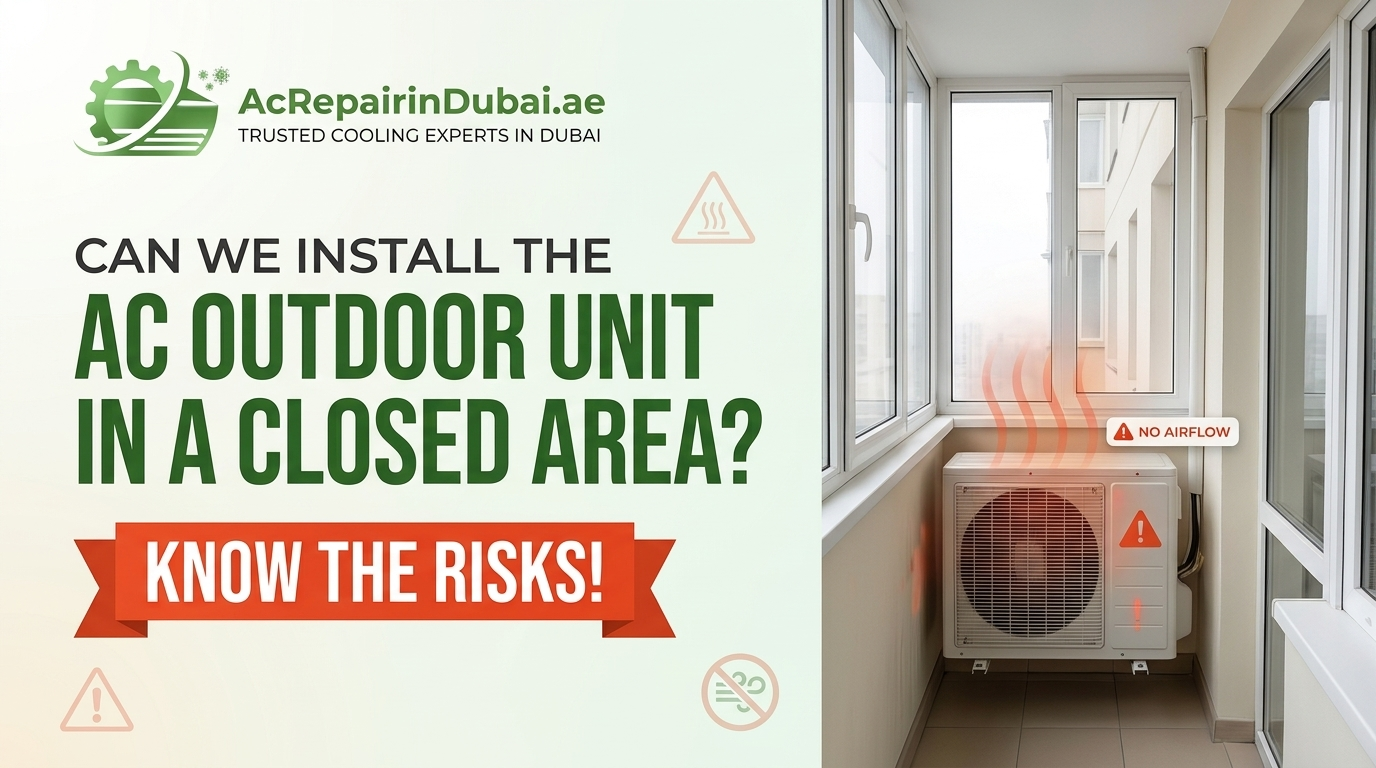
Many property owners ask, can we install the AC outdoor in closed area? The answer depends on how closed the space is. A covered or partly enclosed area can work if fresh air reaches the unit and hot air can leave freely. A fully closed space, such as a small room or a sealed box, is usually unsuitable.
The outdoor unit removes heat from your home and releases it into the surrounding air. If that air cannot move, the unit has to work harder and cooling suffers. This article explains how the outdoor unit works, what can go wrong in an enclosed installation and how to decide whether your location is suitable.
Can We Install the AC Outdoor in Closed Area?
In most cases, a completely closed area is not a good place for an outdoor condenser unit. The unit needs a steady supply of air to remove heat. It also needs space to push the heated air away.
The answer is not always a flat no. Outdoor units can work properly in covered balconies, service ledges and ventilated enclosures where the openings are large and the clearances are correct. Problems start when the space is sealed, cramped or poorly ventilated.
Installation requirements also differ between AC models and manufacturers. Always follow the product specifications and the installation manual for your unit. A general article cannot replace those instructions.
How Does an AC Outdoor Unit Work?
A split AC has two main parts. The indoor unit takes heat out of the room air. Refrigerant carries that heat through copper pipes to the outdoor unit, which is also called the outdoor condenser unit.
Inside the outdoor unit, the compressor pressurises the refrigerant. The refrigerant then passes through the condenser coil. A fan pulls air across the coil, and the heat moves from the refrigerant into that air. The cooled refrigerant returns indoors to absorb more heat.
This process works only when the air around the coil is cooler than the refrigerant inside it. The hot air blown out by the fan must move away from the unit. If it stays nearby and returns to the coil, the system cannot release heat properly.
Why Does the Outdoor Unit Need Proper Ventilation?
Proper ventilation gives the unit two things: fresh air to pull in and a clear path for hot air to leave. Together they support heat dissipation. When either is missing, the air around the coil becomes warmer with every fan cycle. This is called hot air recirculation.
Dubai’s summer makes this more serious. Outdoor air is already hot, so a restricted space can push the air around the coil even higher. Fine dust also settles on the coil and fins, and a closed space keeps that dust close to the unit.
So, can we install the AC outdoor in closed area without ventilation problems? Only if the space lets air flow in and out through large openings, not through small gaps.
Covered Area vs Completely Enclosed Space
A covered area has a roof or overhead cover, but its sides are open. Air moves freely, and the shade can even help the unit. A completely enclosed space has walls and a ceiling on all sides, with few or no openings.
Many real locations fall in between. The important points are the size and position of the openings and whether hot air can escape instead of returning to the coil.
What Happens When the Outdoor Unit Is Installed in an Enclosed Space?
An AC outdoor unit in enclosed space can face several problems. The severity depends on how restricted the airflow is.
- Overheating: The coil and compressor run hotter when the surrounding air is warm.
- Reduced cooling efficiency: The system cannot release heat easily, so the room takes longer to cool.
- Higher electricity consumption: The compressor runs for longer hours to reach the set temperature.
- Compressor stress: High pressure and temperature add load to the compressor, which is one of the costliest parts of the system.
- Frequent breakdowns: Protection devices may switch the unit off, and faults appear more often.
- Shorter equipment life: Continuous strain on parts can reduce the working life of the system.
We do not claim that every enclosed installation will fail quickly. Some units run for a long time in restricted spaces with only a small loss in performance. However, the risk increases with every restriction, especially during long summer running hours.
Common Problems Caused by Poor Outdoor Unit Placement
Technicians see the same patterns on many service visits.
Hot air recirculation. The fan blows hot air out, and a nearby wall, screen or cover sends it back to the coil. The air entering the unit is then hotter than the outside air.
Restricted airflow. Narrow slats, tight panels, stored items and plants reduce the amount of air passing through the coil.
Dust accumulation. A cramped space holds dust near the coil and fins. Over time the coil gets blocked and heat removal becomes weaker. Our guide on how to clean a split AC outdoor unit and condenser coils explains the safe steps.
Unusual noise. A unit with restricted airflow may hum, rattle or run louder than before.
Frequent compressor shutdowns. If the unit stops on hot afternoons and restarts later, the overheating protection may be switching it off.
Can an Outdoor Unit Be Installed on a Covered Balcony?
A covered balcony can be suitable when it has open sides or large openings that allow air to pass through. A closed balcony with glass, solid cladding or sealed panels is different. It traps hot air like a small room.
Before installing on a balcony, check how much open area the space has, whether hot air can move away from the unit and whether other units discharge into the same space. Many apartment buildings provide ledges or shafts for outdoor units. These are usually planned for the purpose, but the louvres must stay clean and clear. For tower projects, our guide on split AC installation in high rise buildings in Dubai explains the common site conditions. Speak to your building management before changing any shared enclosure.
So, can we install the AC outdoor in closed area such as a balcony? Only if it is not truly closed, which means air can enter and leave freely.
Can an Outdoor Unit Be Installed in a Small Room or Utility Area?
A small room or utility area is the riskiest option. Without large, permanent openings to the outside, hot air builds up quickly and the unit starts drawing in its own exhaust air. A closed door makes this worse.
Some utility areas are built with ventilation openings for outdoor units. In such cases, the size and position of the openings matter. A small window or a door left open will not always solve the problem. If you are asking can we install the AC outdoor in closed area such as a store room, a technician should check the space first. If the room cannot provide enough airflow, the unit should be placed outside.
What Is the Ideal Location for Split AC Outdoor Unit Installation?
The ideal location is open to outside air, shaded from direct sun where possible and easy for a technician to reach. It should also be close enough to the indoor unit to keep the refrigerant pipe run within the manufacturer’s limits.
Other points to check include firm support for the unit, safe drainage of water, and discharge air that does not blow towards windows, neighbours or other outdoor units. Our guide on where to install a split AC in a room and what size you need covers indoor placement and sizing as well.
Good installation of split AC outdoor unit starts with choosing the location, because moving it later takes more time and money.
How Much Clearance and Airflow Does an Outdoor Unit Need?
No single distance suits every unit. Each manufacturer gives minimum clearances for the front, back, sides and top in the installation manual. These depend on the model, its size and the design of its air intake and discharge. Follow those figures instead of general guesses.
As a practical rule, the unit should not touch walls, covers or screens on the sides where air enters or leaves. Keep the area in front of the fan free. Do not place a solid cover or shelf directly above the unit. If a technician cannot reach the unit for service, the space is also too tight. Two units placed close together can affect each other as well.
How the Installation Process Works on a Real Job
On a typical job, the technician first inspects the site and checks the available space. They assess the airflow around the proposed position and look at nearby walls, cladding and other units. Then they select a suitable location.
After the location is agreed, the technician mounts the outdoor unit securely and keeps it level. Refrigerant pipes and electrical connections are then completed. Finally, the system is tested and the cooling performance is checked, including whether the discharge air leaves the area freely.
This order matters for AC outdoor unit installation, because airflow problems are easier to avoid during planning than to correct later. If you need help with installing AC outdoor unit at your property, you can read about our AC installation service.
How Can You Improve Ventilation in an Enclosed Installation Area?
If the unit is already in a restricted area, these steps may help:
- Remove stored items, plants and boxes from around the unit.
- Replace solid panels or narrow slats with wide, open louvres.
- Clean dust and debris from grilles and openings.
- Check that nearby units do not blow hot air towards yours.
- Ask a technician about extra openings or an exhaust arrangement designed for the space.
Do not cut openings in walls or change a shared shaft without approval from building management. A small fan or a narrow gap is also not a reliable fix. The right solution depends on the unit model, the size of the space and the heat load. Before deciding can we install the AC outdoor in closed area with extra openings, ask a technician to assess it. Regular AC maintenance also helps keep the coil clean and shows early signs of overheating.
When Should an AC Outdoor Unit Be Relocated?
Consider relocation if the unit overheats or trips repeatedly in hot weather. It is also needed when the space cannot meet the manufacturer’s clearance, when hot air from other units keeps entering yours, or when a technician cannot reach the unit safely for service.
In these cases, cleaning and small changes may give only short relief. A new position may need longer refrigerant pipes, so the manufacturer’s limits for pipe length and height must be checked first.
Why Should a Professional Technician Inspect the Installation Location?
The right answer for your property depends on the AC model, available space, ventilation, pipe layout and site conditions. A technician can compare the clearances with the manual, observe airflow while the unit runs and find whether the problem is heat, dust or something else.
An inspection before installing the unit in an enclosed or restricted space is the safest approach. It helps avoid repeated repairs later. It is also the most reliable way to answer can we install the AC outdoor in closed area for your particular property.
Frequently Asked Questions
Can we install the AC outdoor in closed area if it has a ventilation opening?
It may be possible if the opening is large enough, permanent and placed so hot air can leave. A small opening is usually not enough. A technician should check the space against the manufacturer’s requirements.
Can we install an AC outdoor unit in a closed balcony?
Not if the balcony is sealed with glass or solid panels. A covered balcony with open sides or large openings can work.
Does an AC outdoor unit need fresh air?
Yes. The fan pulls air across the condenser coil to remove heat. The air must be cooler than the coil and must be replaced continuously.
What happens if an outdoor unit has no ventilation?
Hot air builds up around the coil. The unit overheats, cooling drops, power use rises and the compressor may shut down or fail early.
Can an outdoor unit be installed inside a room?
It is not recommended for a standard split AC. A room without large openings to the outside traps hot air quickly.
How much space is needed around an AC outdoor unit?
It depends on the model. The installation manual gives the minimum distances for the front, sides, back and top.
Can poor ventilation affect AC cooling?
Yes. When the unit cannot release heat, the room takes longer to cool and the system may not reach the set temperature.
Is it safe to cover an AC outdoor unit?
A light cover with wide openings and enough clearance can be acceptable. A solid or tight cover that blocks airflow is not safe while the unit is running.
Should I relocate an outdoor unit that overheats?
If cleaning and ventilation changes do not solve the overheating, relocation is often the practical option. A technician can confirm this after inspection.
Who should inspect an AC outdoor unit installation?
A trained AC technician should inspect it. They can check clearances, airflow, pipe layout and electrical connections against the manufacturer’s instructions.
Final Thoughts
A closed area is rarely a good place for an outdoor unit, but a covered or partly enclosed space can work when airflow, clearance and heat removal are properly met. Each location needs a proper check, because the AC model, available space and site conditions all affect the result.
If your outdoor unit is in a tight space or you are planning a new installation, AC Repair in Dubai can inspect the location and advise on the best option. Call or WhatsApp us on +971 55 268 3073 to discuss your requirement.