

Introduction
When your air conditioner keeps running but the room stays warm, it is hard to ignore, especially in the long summer months in Dubai. Most units here work for many hours every day, so a small fault can quickly turn into poor cooling. An AC cooling problem can be as simple as a dirty filter or as serious as a refrigerant leak or a compressor fault.
This guide explains seven common causes of AC not cooling, the signs you may notice and the checks you can do safely. We also explain what our technicians look for during air conditioning repair, so you know which faults need professional help.
1. Dirty or Clogged Air Filters
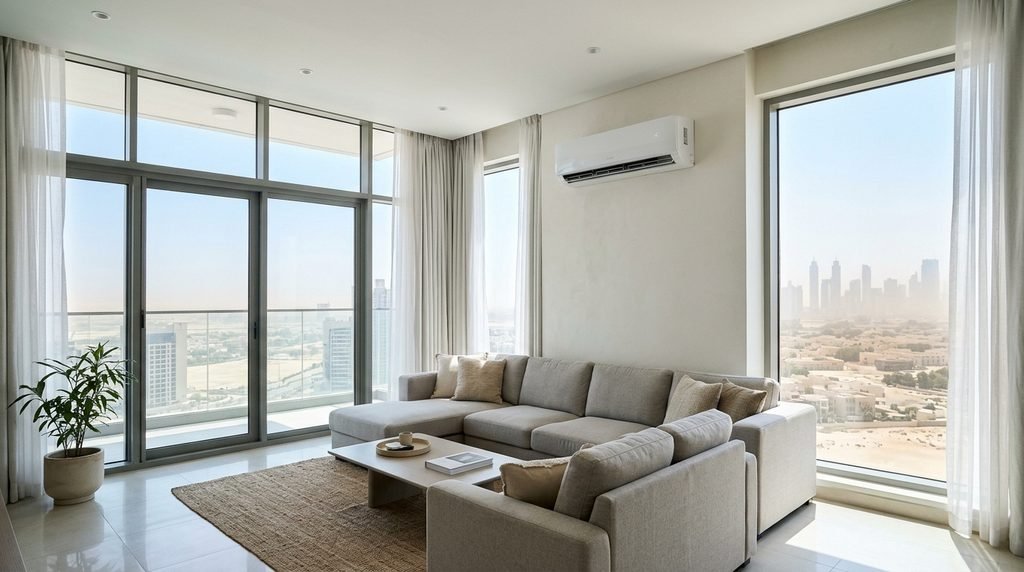
The air filter sits behind the front panel of the indoor unit. It catches dust, sand, hair and lint before air reaches the evaporator coil. When the filter clogs, less air passes through the unit. The coil cannot cool that air properly, so the AC runs longer and the room stays warm. Dirty filters are among the most common reasons for AC not cooling in dusty areas, and a clogged filter is also the simplest AC cooling problem to prevent.
Signs: weak airflow, slow cooling, a dusty smell and rising electricity bills.
Safe check: Switch off the AC, open the panel and look at the filter. If it is dusty, wash it gently with water, dry it fully and fit it back. Do not use hot water, and do not run the AC without a filter.
Technician fix: If the filter is damaged or dust has gone deeper into the unit, we recommend professional AC filter cleaning along with an indoor unit inspection.
2. Dirty Evaporator or Condenser Coils
Your AC has two coils. The evaporator coil inside the indoor unit absorbs heat from room air. The condenser coil in the outdoor unit releases that heat outside. Both need clean metal fins to transfer heat well. Dust, grease and sand on the fins act like a blanket, so cooling performance drops and the compressor works harder. Dirty coils are a quiet AC cooling problem because the loss in cooling happens slowly.
Signs: the AC runs constantly, the air feels only slightly cool, the outdoor unit is very hot or a musty smell comes from the indoor unit.
Safe check: Keep the area around the outdoor unit free of boxes and plants. Do not spray water or chemicals into the unit yourself. The fins bend easily and wrong cleaning can make things worse.
Technician fix: We clean both coils with suitable tools, rinse carefully and flush the drain tray. Any AC cooling coil cleaner must suit the coil material, usually aluminium fins on copper tubes, and be used as per the manufacturer’s instructions. Our AC coil cleaning service covers both evaporator and condenser coils.
3. Low Refrigerant or Refrigerant Leaks
Refrigerant carries heat from the indoor unit to the outdoor unit through a sealed system. It does not get used up like fuel. If the level is low, there is a refrigerant leak somewhere. With less refrigerant, the coil cannot absorb enough heat, so the air feels warm or only mildly cool. This kind of AC cooling problem will not improve on its own.
Signs: ice on indoor pipes, a hissing sound, oily marks near pipe joints or an AC that stopped cooling slowly over a few weeks.
Safe check: There is nothing you should check inside the system. Handling refrigerant needs training and proper tools. Please note the signs and report them.
Technician fix: We check pressures, locate the leak, repair it and then refill to the correct level. Adding gas without finding the leak is not a proper repair. The gas escapes again, cooling drops again, and low refrigerant can strain the compressor.
4. Incorrect Thermostat Settings or a Faulty Thermostat
The thermostat tells the AC when to cool and when to stop. Sometimes the issue is only the setting. The mode may be on fan or dry, or the temperature may be too high. A faulty thermostat or sensor is different. It reads the wrong room temperature, so the compressor may stop early or not start at all.
Signs: the unit switches on and off often, the room temperature does not match the set value or the indoor fan runs while the outdoor unit stays off.
Safe check: Set the mode to cool, choose a sensible temperature such as 24°C and replace the remote batteries. Make sure the thermostat is not in direct sunlight.
Technician fix: We test the sensor and control board and replace the thermostat if needed. Our guide on AC thermostat replacement in Dubai explains compatibility and cost factors.
5. Frozen Evaporator Coils
When ice forms on the evaporator coil, it blocks airflow and stops heat absorption, so the AC blows weak air. A frozen coil is a common AC cooling problem and it always has a reason, usually a dirty filter, a dirty coil, a weak indoor fan or low refrigerant. The ice then melts and can overflow the drain tray.
Signs: frost on the indoor unit or copper pipes, water dripping and very little air from the vents.
Safe check: Switch the AC to fan mode so the ice melts. Keep a towel below for drips. Do not chip the ice, as it can damage the coil. Check the filter while you wait.
Technician fix: Defrosting only clears the ice for a short time. If it returns, we find the root cause, whether it is airflow, refrigerant or a fan fault. We also check the drain line, since a blocked drain causes leaks and, on some systems, a float switch can stop the unit when the tray is full. Our guide on cleaning an AC drain line to stop water leaks explains the basics.
6. Blocked Air Ducts or Restricted Airflow
Cool air must reach the room freely. In ducted and central systems, closed vents, dirty ducts, leaking duct joints or a collapsed flexible duct reduce airflow. In split units, curtains, furniture or a blocked louvre can stop air reaching the room. An outdoor unit placed in a closed space also struggles to release heat. Many AC cooling issues of this type are blamed on the AC itself when the real fault is restricted airflow.
Signs: some rooms stay warm while others cool well, weak air from certain vents or whistling sounds from ducts.
Safe check: Open all supply vents, move furniture or curtains away from them and make sure the outdoor unit has free space around it.
Technician fix: We check the blower, duct connections, dampers and outdoor fan, then clean or repair whatever restricts airflow. Ducted units are often reached through ceiling panels, so this work is best left to a technician.
7. Compressor or Electrical Problems
The compressor pushes refrigerant through the coils. If it cannot start or run properly, the indoor fan may still blow air but real cooling stops. Electrical parts such as the capacitor, contactor and wiring help the compressor and outdoor fan start, so a fault in any of them gives the same result. This is the most serious AC cooling problem on this list.
Signs: warm air, an outdoor unit that hums but does not start, loud noises, a burning smell or a tripping breaker.
Safe check: Reset the circuit breaker once. If it trips again, leave the AC off. Never open the outdoor unit or touch the wiring.
Technician fix: We test voltage, current draw, the capacitor, contactor and compressor with proper meters. A small part may solve the fault. A failed compressor on an older unit may cost close to a new system, so the technician explains repair and replacement options. Costs depend on the AC type, the fault, the parts and the labour.
What to Check When Your AC Has Stopped Cooling
If you are wondering why AC is not cooling, start with these basic checks. Stop if you are unsure about any step.
- Confirm the thermostat is in cool mode with a sensible temperature.
- Look at the air filter and clean it if it is dusty.
- Check that the outdoor unit fan is running and nothing blocks the unit.
- Open all vents and remove anything blocking the airflow.
- Look for ice on the indoor unit or pipes.
- Check the circuit breaker once.
If Your Split AC Is Not Cooling
A split AC not cooling needs checks on both units. The indoor unit should blow steady air and the outdoor unit fan should be running. If the indoor unit blows air but the outdoor fan is not running, the fault is likely electrical or with the compressor, and split AC repair is needed. Do not keep running the unit for days.
When You Need Professional AC Repair
Book an AC inspection if your AC stopped cooling even after these checks, ice keeps returning, the breaker trips, the outdoor unit does not start, or you notice hissing, a burning smell or unusual sounds. Cleaning helps when dirt is the cause, but it will not repair a leak, a weak capacitor or a failed compressor.
On a visit, we inspect the filters, coils, drain, airflow, refrigerant pressure and electrical parts, then test cooling performance. We explain the fault and the repair before work begins. The final cost depends on the AC type, the fault, the parts, the labour and the complexity of the job.
Regular AC maintenance before summer helps catch small faults early, and AC servicing in Dubai is easier to plan before the peak heat arrives.
Frequently Asked Questions
Why is my AC running but not cooling?
Common reasons are a dirty filter, dirty coils, a refrigerant leak, wrong thermostat settings, a frozen coil or a compressor fault. Check the mode and filter first, then book an inspection if cooling does not improve.
What should I check when my AC stops cooling?
Check the thermostat mode, filter, outdoor unit, vents, any ice and the breaker. If these do not help, a technician should inspect the unit.
Can a dirty AC filter cause cooling problems?
Yes. A dirty filter restricts airflow and can lead to a frozen coil. Clean it regularly, and more often in dusty homes.
Can dirty AC coils affect cooling?
Yes. Dirt blocks heat transfer, so the unit cools less and uses more power. Coil cleaning can restore performance when dirt is the cause.
Does low refrigerant cause an AC cooling problem?
Yes, but refrigerant is not used up in normal running. A low level points to a leak, which needs repair and not only a top up.
Why is my split AC not cooling properly?
The usual causes are dirty filters or coils, a blocked outdoor unit, wrong settings, a refrigerant leak or an electrical fault. Check both the indoor and outdoor units.
How often should AC coils be cleaned?
Many units need coil cleaning every 6 to 12 months. Homes near construction, open desert or busy roads may need it sooner.
Can I use an AC cooling coil cleaner myself?
We do not advise it for indoor coils. Sprays near electrical parts and the wrong product can damage fins or leave residue. Wash the filter and keep the outdoor unit clear, and leave coil cleaning to a technician.
How long does it take to fix an AC cooling problem?
Filter or coil cleaning on a split unit is often done in one visit. Leak repair, part replacement or compressor work can take longer, especially if parts must be ordered.
Get Your AC Checked Properly
An AC cooling problem rarely fixes itself. If your AC keeps freezing, makes unusual sounds or smells, or has stopped cooling, arrange an inspection early. You can call or WhatsApp us on +971 55 268 3073 and share your AC type and area.



Pingback: How to Install AC Compressor: Tools, Steps and Safety